Behavioral Finance: Understanding the Human Side of Investing
Behavioral finance is a field of study that examines how psychological factors, emotions, and cognitive biases influence financial decision-making. Traditional finance assumes that individuals are rational, always act in their best interest, and make decisions based on complete information. However, real-world behavior often contradicts this assumption. Investors frequently make choices driven by fear, greed, overconfidence, or social influence rather than logic and objective analysis.
Behavioral finance bridges the gap between economics and psychology by explaining why people make irrational financial decisions and how these decisions affect markets, asset prices, and investment outcomes.
Evolution and Importance of Behavioral Finance
Behavioral finance emerged as a response to the limitations of traditional financial theories such as efficient market hypothesis and rational choice theory. Researchers observed recurring patterns of irrational behavior in markets, including speculative bubbles, market crashes, and persistent mispricing of assets.
By incorporating insights from psychology, behavioral finance provides a more realistic understanding of investor behavior. It is now widely applied in portfolio management, financial planning, risk assessment, and policy formulation. Understanding behavioral finance helps investors recognize their own biases and make more disciplined financial decisions.
Key Assumptions of Behavioral Finance
Behavioral finance is based on several core assumptions:
- Investors are not always rational
- Emotions significantly influence financial decisions
- Cognitive shortcuts, known as heuristics, affect judgment
- Market outcomes are shaped by collective human behavior
These assumptions explain why markets may deviate from fundamental values and why anomalies can persist over time.
Common Behavioral Biases in Finance
1. Overconfidence Bias
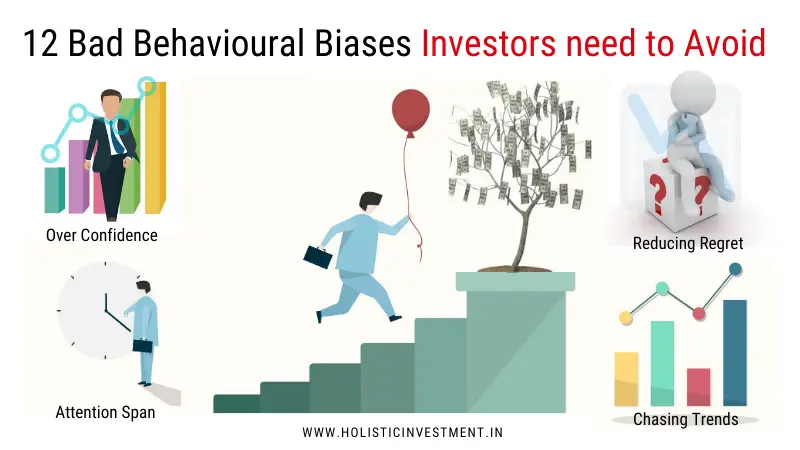
Overconfidence bias occurs when investors overestimate their knowledge, skills, or ability to predict market movements. Overconfident investors tend to trade excessively, underestimate risks, and ignore contradictory information, often leading to poor investment performance.
2. Loss Aversion
Loss aversion refers to the tendency to feel the pain of losses more intensely than the pleasure of gains. As a result, investors may hold on to losing investments for too long or avoid taking necessary risks, even when potential returns justify them.
3. Herd Behavior
Herd behavior describes the tendency of individuals to follow the actions of a larger group. In financial markets, this can lead to speculative bubbles when investors buy assets simply because others are doing so, or panic selling during market downturns.
4. Anchoring Bias
Anchoring bias occurs when individuals rely too heavily on initial information, such as a past stock price, when making decisions. This can prevent investors from accurately reassessing an investment based on new data or changing market conditions.
5. Confirmation Bias
Confirmation bias leads investors to seek information that supports their existing beliefs while ignoring evidence that contradicts them. This selective perception can result in flawed analysis and suboptimal investment choices.
Role of Emotions in Financial Decisions
Emotions play a powerful role in shaping financial behavior. Fear often drives investors to sell assets during market declines, locking in losses. Greed, on the other hand, can lead to excessive risk-taking during periods of market optimism.
Emotional responses are particularly strong during periods of high volatility, when uncertainty increases and rational analysis becomes more difficult. Behavioral finance emphasizes the importance of emotional discipline and long-term perspective in managing investments.
Behavioral Finance and Market Anomalies
Behavioral finance helps explain several market anomalies that traditional theories struggle to justify. These include:
- Market Bubbles: Prices rise far above intrinsic value due to speculative enthusiasm
- Market Crashes: Sudden declines triggered by panic and loss of confidence
- Momentum Effects: Assets that perform well continue to attract investors, pushing prices higher
- Underreaction and Overreaction: Markets respond too slowly or too strongly to new information
Such anomalies highlight the impact of collective human behavior on financial markets.
Applications of Behavioral Finance
Investment Strategy
Investors and fund managers use behavioral finance insights to design strategies that reduce emotional decision-making. Systematic investment approaches, diversification, and disciplined rebalancing help counteract common biases.
Financial Planning
Financial advisors apply behavioral finance principles to understand client behavior, manage expectations, and encourage long-term commitment to financial goals. By addressing emotional responses, advisors can help clients avoid impulsive decisions.
Risk Management
Behavioral finance improves risk management by identifying psychological factors that lead to excessive risk-taking or undue conservatism. Awareness of biases allows for better assessment and control of risk exposure.
Policy and Regulation
Regulators use behavioral insights to design policies that protect investors, promote transparency, and reduce systemic risk. Behavioral finance has influenced disclosures, default investment options, and investor education initiatives.
Managing Behavioral Biases
While biases are natural, they can be managed through conscious effort and structured decision-making. Effective strategies include:
- Setting clear investment goals and rules
- Diversifying portfolios to reduce emotional attachment
- Avoiding frequent portfolio monitoring
- Seeking objective advice and independent analysis
- Focusing on long-term outcomes rather than short-term fluctuations
Self-awareness is the first step toward improving financial behavior.
Behavioral Finance in the Modern Financial World
With the rise of digital trading platforms and real-time information, behavioral biases can be amplified. Easy access to markets encourages impulsive trading, while constant news updates intensify emotional reactions.
At the same time, technology also offers tools such as automated investing and data-driven analytics that help reduce emotional interference. Behavioral finance continues to evolve as it adapts to changing market dynamics and investor behavior.
Behavioral finance provides valuable insights into how psychology and emotions influence financial decisions. By challenging the assumption of complete rationality, it offers a more realistic framework for understanding investor behavior and market movements.
Recognizing behavioral biases enables investors to make more informed, disciplined, and rational choices. In an environment shaped by uncertainty and emotion, applying behavioral finance principles is essential for achieving consistent and sustainable financial success.